


Meta Muse lives where Meta's apps live: in the Muse app, on the web, in WhatsApp, and in Instagram DMs. Telegram is not on that list. Meta has not released a Telegram integration for Muse, so out of the box Muse cannot read your Telegram chats, search them, or send a reply on your behalf.
What Muse can do is use outside tools through an MCP server. MCP (the Model Context Protocol) is the open standard that lets an AI app call outside tools, and Muse can use any remote MCP server through a custom connector. This guide connects Muse to Telegram using Automata, a free, open-source Telegram MCP server that links your personal account as an extra device and lets you choose exactly which chats Muse can see and which actions it can take.
Don't want to run anything yourself? Automata has a hosted option at mcp.getautomata.app. Sign up, link Telegram, and use https://mcp.getautomata.app/mcp as the URL in step 2.
Muse on Telegram vs Muse with your Telegram
Searching for "Muse Telegram" turns up two different things, and it is easy to mix them up:
| Community Telegram bots | Muse + Automata | |
|---|---|---|
| Made by Meta | No | No, but uses Muse's official custom connectors |
| Direction | You message a bot from Telegram | Muse reaches into your Telegram |
| Read your chats | No, only messages sent to the bot | Yes, only the chats you allow |
| Search old messages | No | Yes |
| Send a reply as you | No, it replies as the bot | Yes, only if you enable it, one token at a time |
| Who sees what | Whatever the bot is sent | Only the chats on the connector token |
Talking to Muse from Telegram. Some community projects wrap an AI model in a bot you create with BotFather, so you can message it from Telegram. These are not made or supported by Meta. And like every Telegram bot, they only receive messages sent to the bot or posted in groups the bot was added to. They cannot see your existing conversations, search your history, or reply as you.
Giving Muse your Telegram. If you want Muse to answer questions like "which groups need a reply from me?" or "draft a reply to the Launch team", it needs access to the chats in your own account. Automata provides that access, limited to the chats and actions you put on the connector token.
Some guides suggest a shortcut: log in to Telegram Web inside an AI agent's browser by scanning its QR code. That hands over your whole account, with every chat visible and nothing stopping it from sending. With Automata, the token decides which chats Muse can see and whether it can send at all.
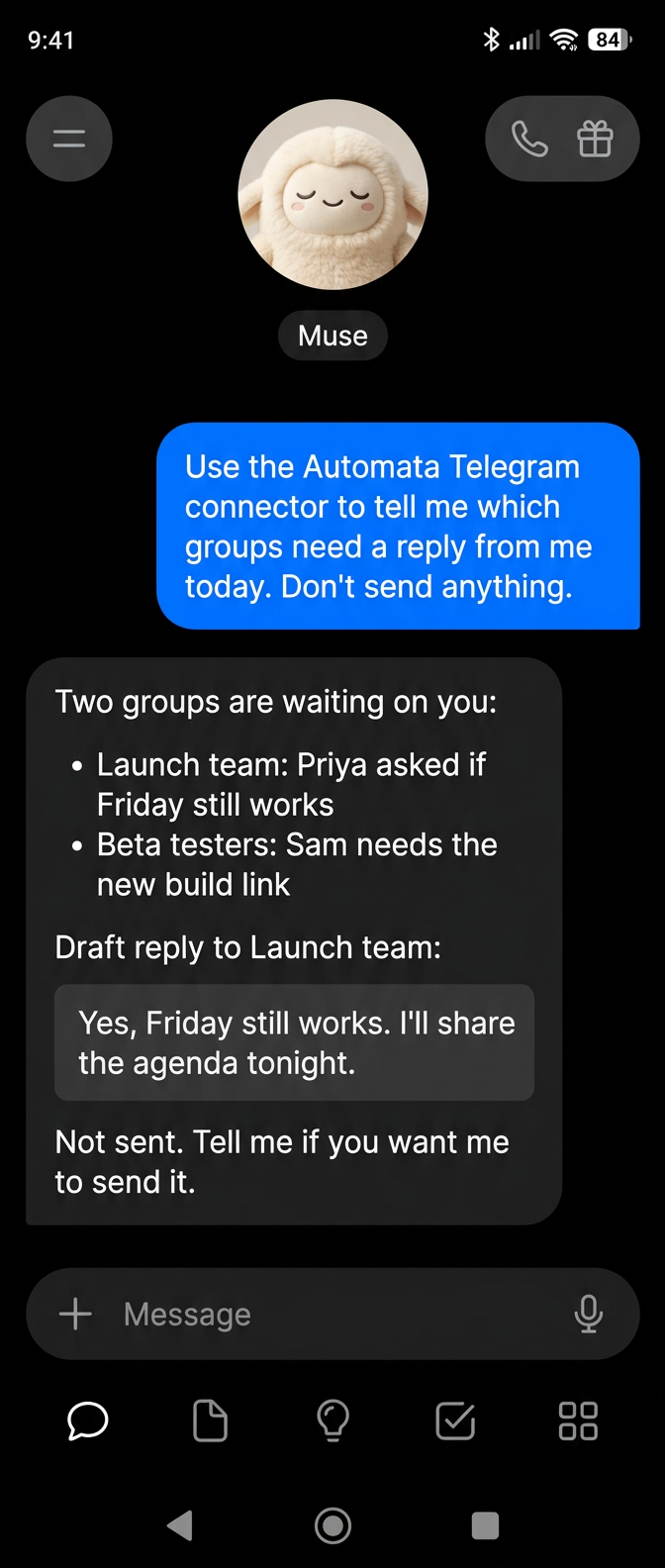
With Automata, Muse gets five Telegram tools:
get-telegram-statuschecks that your account is linked and shows sync progress.list-telegram-chatslists the chats, groups, and channels you allowed.read-telegram-messagesreads the history of one allowed chat, including forum topics.search-telegram-messagessearches message text and captions across the allowed chats.send-telegram-messagesends a text message to an allowed chat, if the token includes this tool.
What you need
- A Telegram account.
- The Muse app on your phone, or Muse on the web, signed in to an account that can create custom connectors. Meta is still rolling out Muse features, so if you do not see custom connector support yet, check back after your account updates.
- Automata, either hosted at mcp.getautomata.app (no server to run), or your own instance with a public HTTPS URL. Muse runs in Meta's cloud, so it cannot reach
localhostor a private network. For self-hosting, the quickest option is the one-click Railway template; you can also self-host with Docker. Self-hosting also needs your own Telegram API ID and API hash from my.telegram.org. - A Telegram account already linked in Automata and a connector token. If you have not done that yet, follow steps 1 to 3 of How to connect Claude to Telegram; they are identical for every client.
- About ten minutes.
How the connection works
Three pieces are involved, and only the middle one is new:
- Muse is the MCP client. It sends requests to a URL from Meta's cloud and attaches your key.
- Automata is the MCP server. It checks the key on every request, enforces which chats are allowed, and exposes the Telegram tools.
- Telegram is linked to Automata as an extra device, the same way Telegram Desktop is. Automata stores an encrypted session and syncs your chats, so Muse never sees your session, your phone number, or your login code.
Because the permission check happens in Automata and not in the prompt, Muse cannot talk its way into a chat you did not allow. Read more about how Automata enforces permissions.
Step 1: Get your endpoint and key
Open your Automata dashboard and create a connector token for your Telegram connection. Each connector token has two settings. Chats decides which conversations it can see. Actions decides which tools it can call: the read tools, and send-telegram-message to send. The two are independent, so a token that can send can send to any chat on its list.
A new token starts with all chats and all actions, so narrow both: choose Only selected chats, then Only selected actions with just the read tools: get-telegram-status, list-telegram-chats, read-telegram-messages, and search-telegram-messages. To let Muse reply in one group only, create a separate token for that group with sending enabled. You need two values:
Endpoint: https://mcp.getautomata.app/mcp
Authorization: Bearer <connector-token>
If you use hosted Automata, the endpoint is always https://mcp.getautomata.app/mcp, and you create the token from your hosted dashboard.
Automata uses a bearer API key rather than OAuth sign-in, so you will give Muse the key, not log in to anything. The MCP clients docs cover the other endpoint formats.
Anyone with the token can use the chats it allows. Do not paste it into a public chat or a screenshot, and do not type it into your conversation with Muse. If it leaks, revoke that one token in Automata and create a new one.
Step 2: Ask Muse to create a custom connector
Muse does not have an "add MCP server" button. You add one by asking Muse, in a normal chat, to create a custom connector. Give it the name, the transport, the URL, and how the server authenticates, all in one message:
Create a Custom Connector for a new remote MCP server, then connect to it:
Name: Automata Telegram
Transport: remote streamable HTTP
URL: https://mcp.getautomata.app/mcp
Auth: API key sent as Authorization: Bearer
Muse recognizes that this is not one of its catalog connectors and sets it up as a custom one. It will tell you the connector can act on your Telegram account through Automata, and may ask you to confirm before it continues.
If you already added Automata for WhatsApp, give this one a different name, such as Automata Telegram, and use the Telegram connection's token. Each token belongs to one connection, so the WhatsApp token will not show your Telegram chats.
Step 3: Enter the key in the secure prompt
When Muse asks for the key, enter your connector token in its secure credentials prompt, not as a normal chat message. Anything you type into the conversation can end up in your chat history, while the secure prompt stores the key with the connector.
If Muse offers only an OAuth sign-in and no API key option, say so and ask it to use an API key sent as a bearer token. Automata does not use OAuth for connector tokens.
Step 4: Confirm the tools are connected
Once the key is saved, Muse tests the connector and lists the tools it found. It may also save the connector as a reusable skill, so you do not need to repeat this setup in future chats. You can review or disconnect it later from Settings → Connectors.
The tool count depends on your token. Automata only registers the tools in the token's Actions setting, so a read-only token shows four tools and one that can also send shows five. If the count is lower than you expected, check the token's Actions in your dashboard. Chat choices never change the count.
Step 5: Test it
Start with a safe, read-only request before asking for anything that sends a message. Try:
Use the Automata Telegram connector to check the Telegram connection status.
Muse calls get-telegram-status and should report the account as linked, along with how far the history sync has got. Then move to prompts that match the chats you allowed:
- Which of my Telegram groups need a reply from me today?
- Summarize what the Launch team discussed this week.
- Find the link Sam shared in the Dev chat on Tuesday.
- List every question in the Beta testers group that nobody has answered.
- Draft a reply to the Launch team confirming Friday. Do not send it.
No Telegram bot can do any of these, because they all depend on chats a bot never sees. With a token that has sending enabled for a single group, you can go one step further and ask Muse to send the reply it drafted. Muse asks for your approval before it sends, and the message goes out from your own account, not from a bot.
Ask Muse about a chat you did not allow and it will not find it. That is the permission layer working as intended.
Keep it safe
- Start read-only. Limit the token to one or two chats and the read tools first. If Muse needs to reply in one group, create a separate token for that group with sending enabled.
- Keep approvals on. Muse asks before important actions by default. Read the message it is about to send, and keep that confirmation on so every outgoing message is one you approved.
- Use a separate token for Muse. You can then revoke it without breaking Claude, Grok Bot, or any other client.
- Watch for prompt injection. Public groups and channels are full of text written by strangers, and any of it can contain instructions aimed at the AI. Keep sending off unless you need it, and review anything Muse proposes before approving it.
- Leave out what you would not share. Secret chats are never synced, but cloud chats are. Only put chats on the token that you are comfortable sending to Meta's cloud for processing.
Troubleshooting
| Symptom | Likely cause and fix |
|---|---|
| Muse cannot reach the server | The URL is not public or not HTTPS. Muse runs in Meta's cloud, so use your deployed Automata URL, not localhost, and make sure it ends in /mcp. |
Muse reports a 401 error | The key is missing, invalid, expired, or revoked. Create a new connector token and save it again through the secure prompt. |
| Muse only offers OAuth | Ask it to create the connector with an API key sent as a bearer token. Automata does not support OAuth sign-in for connector tokens. |
| No custom connector option | Custom connectors may not have reached your account yet. Check Settings → Connectors and try again later. |
| Fewer tools than expected | The token's Actions setting allows only some tools. Edit the token and add the tools you need, then reconnect the connector in Muse. (Chat choices don't change the tool count.) |
| Muse shows WhatsApp chats instead | You saved the WhatsApp connection's token. Create a token for the Telegram connection and save it on a connector named Automata Telegram. |
| A chat is missing from the results | It is not allowed on this token, it is a secret chat, or it is a broadcast channel and channel backfill is off. |
| Older messages are missing | History is still backfilling, or it hit the per-chat or day limit. get-telegram-status shows sync progress. |
| The account keeps unlinking | When self-hosting, two bridge processes are competing for the session, or the encryption key changed. Run one replica and keep the key stable. |
More fixes are in the Telegram connection docs and the troubleshooting guide.
Frequently asked questions
Does Meta Muse work with Telegram?
Not on its own. Meta has released Muse in its own app and on the web, WhatsApp, and Instagram, but not in Telegram. Any Telegram bot that claims to be Muse is a community project, not an official Meta product. To let Muse work with your Telegram chats, connect it to a Telegram MCP server such as Automata through a custom connector.
Can Meta Muse read my Telegram chats?
Only through a tool that gives it access. With Automata, Muse can list, read, and search the chats, groups, and channels you put on the connector token. It cannot see any chat you leave off, and it never sees secret chats.
Can Muse send Telegram messages for me?
Yes, if you allow it. Muse can send a message if the connector token includes the send-telegram-message action and the chat is on the token's list. Muse asks for your approval before sending, and a read-only token cannot send anything.
Does it use the Telegram Bot API?
No. Automata links your personal account as an additional device, so Muse can work with your own chats rather than only the chats a bot has been added to. Messages you approve are sent from your account.
Is it free to connect Muse to Telegram?
Yes. Automata is MIT licensed and free to self-host, including the one-click Railway template. A hosted version is available at mcp.getautomata.app.
Next steps
- Connect Muse to your other inbox with How to connect Meta Muse to WhatsApp.
- Use the same Telegram connection from Claude or Grok Bot, and see every endpoint format in the MCP clients guide.
- Read the Telegram MCP overview for what the five tools do and how scoped access compares to other servers.
- Check every tool parameter in the MCP tools reference.
Comments
Questions, corrections, or your own setup? Join in below. Pick any name to post.